
Guide of Fiber Optic Splice Tray
Fiber optic splice tray is a device used to connect fiber optic cables. It can splice and branch fibers, guide them into the tray and then fuse them together before sealing them inside.
The tray cover can be flipped and the tray can be stacked to increase capacity, making installation and use extremely convenient. It's a fiber optic distribution product that consists of plastic components.
Instead of being passively connected, the fusion splice tray allows for each fiber to be connected to any other fiber, enabling flexible networking.
It installs inside the fiber optic distribution box, where some of the fiber optic cables are spliced with pigtails for network routing, while others are directly connected through fusion splicing. The splice tray can connect any two fibers, making it highly versatile.
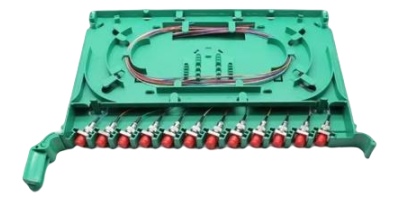
The fusion splice tray is made of high-strength engineering plastics, which are injection-molded to ensure high flame resistance, strength and long anti-aging properties. It's a reliable solution for connecting fiber optic cables.
.
1. Features of fiber splice tray
- Fiber fusion splice trays are available in 4, 6, 8, 12 and 24 core sizes.
- Each tray has separate pathways for pigtails and fiber optic cables, allowing for efficient management and protecting fiber from damage.
- The tray has a three-layered structure with a distribution tray at the bottom, a splice tray in the middle and a cover on top, providing combination splicing and distribution functions that are easy to operate.
- The tray is compatible with four types of adapters, including FC, SC, LC and ST adapters, also can use with ribbon, beam and non-ribbon fiber optic cables.
- The bend radius for fibers can be greater than 40MM, providing installation flexibility.
- Adapters and splice units are tilted at a 30-degree angle to maintain the jumper's bending radius and prevent laser damage to the eyes.
2. How to install fiber optic splice tray
To install a fiber fusion splice tray, please note the following steps:
- Strip the outer layer of the fiber optic cable to expose the bare fiber core (usually 1.1M in length). Then, fix the two fiber optic cables on both ends of the cable terminal box.
- Clean the bare fiber core with alcohol wipes and use a Fiber cutter to cut the fiber core. The section of the fiber core must be cut flat. Then put into a heat shrinkable tube.
- Place the two fiber cores into the fiber fusion splicer and fuse them together. After the fusion is complete, heat the heat shrinkable tube to make it shrink and adhere tightly to the fiber core.
- After completing a set of fusions (usually eight, but can also be four or sixteen), the exposed fiber core is about 2.2M, while the cable terminal box is generally 30cm or 15cm. Therefore, the exposed fiber core needs wrap into an elliptical shape and placed in the fiber fusion splice tray and then secured.
- After all the fibers are connected, put a heat-shrinkable tube over the cable terminal box and heat it to make it shrink tightly to the cable. This prevents rainwater or moisture from entering the cable terminal box through gaps.
3. What is fiber optic integrated tray
The integrated tray is a versatile solution used for fiber optic splicing and branching. Key features include:
- Fiber optic splicing and branching: The integrated tray allows for efficient fiber optic splicing and branching.
- Convenient design: The cover can be flipped and the tray can be stacked to increase capacity, making installation and use convenient. It is made of plastic components.
- High-strength materials: The splice tray is made of high-strength engineering plastics that are injection-molded to ensure high flame resistance, strength and long anti-aging properties.
- Modular design: The tray has a single unit box for fiber optic splicing, tray storage, and distribution and each fusion and distribution module can be individually removed to meet off-rack or on-rack operations.
- Clear management: The tray allows for clear management of fiber optic cables, pigtails, and jumpers with good operability. It is compatible with various adapters, such as FC and SC.
- Technical specifications: The tray operates at a nominal wavelength of 850nm, 1310nm and 1550nm, and has an insertion loss of ≤0.5dB. It also has a return loss of PC ≥40dB, UPC ≥50dB, APC ≥60dB, and can withstand a voltage of ≥3KV(DC)/1min without breakdown or arcing. The insulation resistance is ≥1000MΩ/500V(DC), and the longevity is ≥1000 times.