The Importance of Drop Cables in Outdoor Environments
In modern telecommunications and fiber optic networks, drop cables, also known as butterfly or indoor/outdoor cables, play a crucial role in providing reliable connectivity to end-users.
With their unique design and technical specifications tailored to different application environments, drop cables have become an optimal solution for various network deployments, including smart buildings, digital communities, campus networks, and local area networks.
This article will explore why drop cables are essential for outdoor environments and how they combine the characteristics of indoor and self-supporting cables to meet the demands of FTTX networks.
Understanding Drop Cables
Drop cables, also referred to as optical fiber patch cords, are an integral part of communication network cable assemblies.
They consist of one or more optical fiber lines, often housed within protective sheaths or jackets, which serve as the transmission medium for data transfer.
Unlike traditional cables that may contain metallic materials such as copper or aluminum, communication drop cables are primarily composed of optical fibers (thin strands of glass) and plastic protective layers.
This composition ensures efficient and reliable transmission of optical signals without interference caused by electromagnetic interference (EMI) or radio frequency interference (RFI).
Why Do We Need Drop Cables in Outdoor Environments?
-
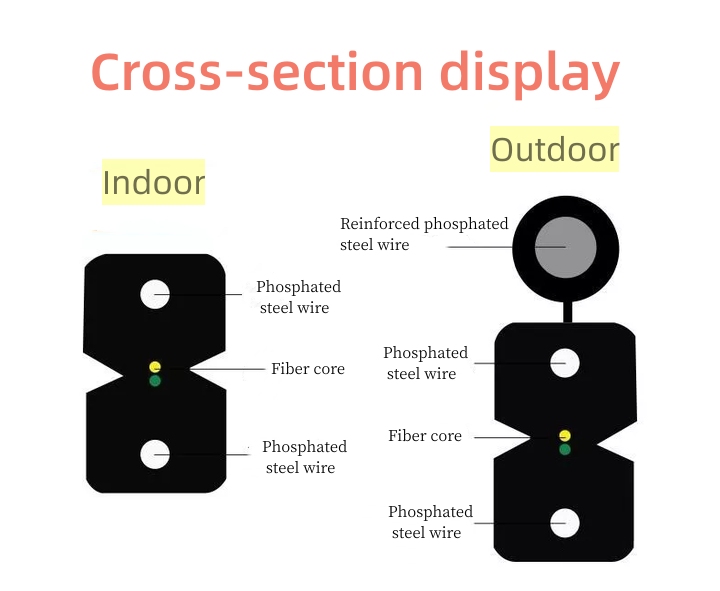
Enhanced Structure: Drop cables are designed with a standardized figure-eight configuration. They typically feature two horizontal strength members with optical fiber lines in between. Self-supporting drop cables further enhance this structure by adding a robust steel wire for additional strength. This design enables reliable installation and suspension of the cable over long distances, making it suitable for outdoor environments.
-
Weather Resistance: Outdoor environments expose communication cables to various weather conditions, including rain, UV radiation, temperature fluctuations, and physical stress. Drop cables are engineered to withstand these challenges. The protective sheaths and jackets offer excellent resistance to moisture, UV radiation, and other environmental factors, ensuring long-term performance and durability in outdoor settings.
-
Easy Installation: Drop cables are designed for easy and efficient installation. Their lightweight construction and flexible nature simplify deployment, enabling faster and cost-effective network installations in outdoor environments. The standardized figure-eight structure allows for convenient suspension and connection to support poles or other mounting points.
-
Seamless Integration: By combining the characteristics of indoor and self-supporting cables, drop cables seamlessly integrate into various network architectures. They can be used for both indoor and outdoor applications, making them versatile and adaptable to different network deployment scenarios.
Conclusion
Drop cables, or butterfly cables, have emerged as a vital component in modern telecommunications and fiber optic networks.
Their unique design and technical specifications make them an optimal choice for outdoor environments, delivering reliable connectivity in FTTX networks.
With enhanced structure, weather resistance, easy installation, and seamless integration capabilities, drop cables provide a robust and efficient solution for establishing reliable communication links in outdoor environments.
Whether it's for smart buildings, digital communities, campus networks, or local area networks, drop cables offer the necessary reliability and performance required for successful network deployments in outdoor settings.
Choose high-quality drop cables from Fibeye to ensure seamless connectivity and optimal performance in your outdoor communication networks.
Contact us today to explore our range of drop cable solutions tailored to your specific requirements!