The Structure of Drop Cable: A Comprehensive Guide
Drop cable plays a pivotal role in indoor wiring, providing a direct connection from the telecommunication network to the end-users.
Understanding its structure is crucial to ensure optimal performance.
In this blog post, we'll delve into the structure of ordinary and self-supporting drop cable, the butterfly-shaped drop cable and the techniques used for their splicing.
1. Ordinary and Self-Supporting Drop Cable
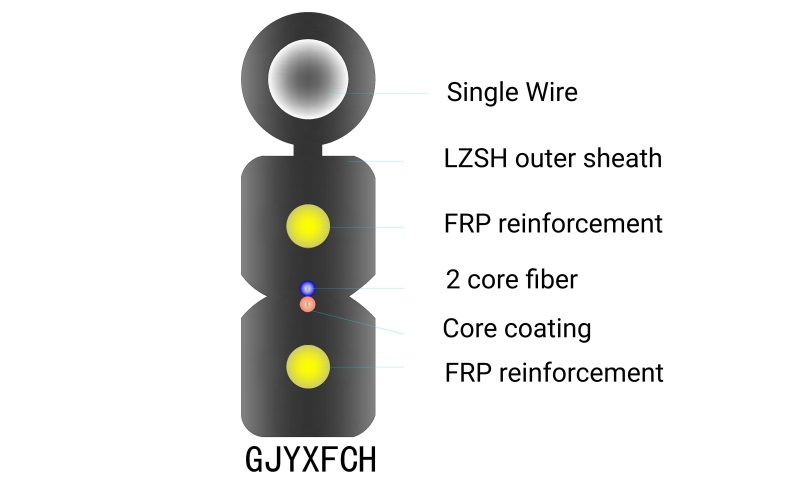
An ordinary drop cable utilizes a standard figure-eight structure, with two parallel strengthening cores and an optical fiber in the middle.
A self-supporting drop cable, on the other hand, adds a thick steel wire suspension to the ordinary drop cable structure.
Essentially, the self-supporting drop cable only differs from the ordinary drop cable by the addition of a steel wire; everything else remains unchanged.
2. Butterfly-Shaped Drop Cable
This type of cable gets its name from its butterfly-like cross-sectional shape.
The structure of the butterfly drop cable can vary among different manufacturers, but it typically consists of non-metallic strengthening cores, with the optical fiber located in the middle, and the strengthening elements on the sides.
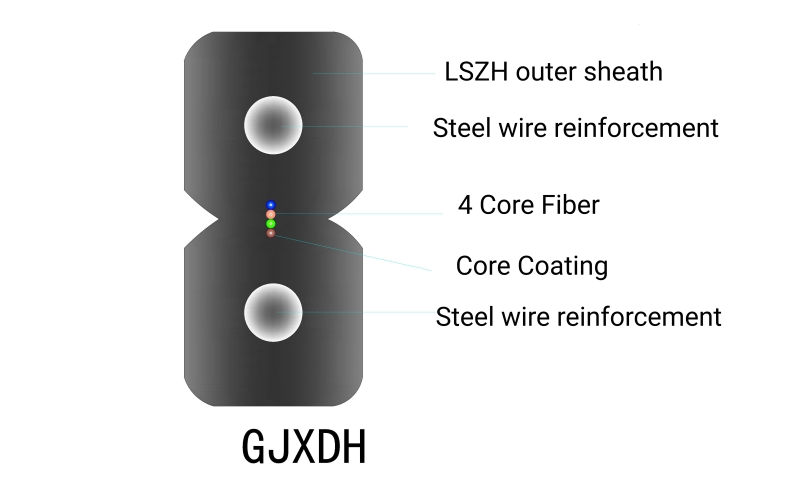
Butterfly cables come in indoor and outdoor versions.
The outdoor version is roughly double the price of the indoor one.
During the design phase, cost should be considered: use ordinary optical cable (GYTA-G 652D) for outdoor purposes, and indoor butterfly cable for indoor use. The two can be transitioned via fiber distribution boxes or joint boxes.
The butterfly cable is characterized by its small bending radius, lightweight, superior bend-resistance, easy fixing, and easy-end connection in the 86 terminal box.
3. Non-Metallic vs Metallic Strengthening Components
Butterfly drop cables come in two forms: those with non-metallic strengthening components and those with metallic ones.
To prevent lightning and strong electrical interference, it's advisable to use non-metallic strengthening component butterfly cables indoors.
For residential user access, a single-core butterfly drop cable is generally recommended, while for business user access, a 2-4 core butterfly cable can be designed.
4. Splicing Techniques: Cold Splicing vs Fusion Splicing
The two main splicing techniques employed in FTTX projects involving drop cables are cold splicing and fusion splicing.
Cold Splicing
Cold splicing involves the preparation of fiber end faces to install a connector, which is then connected using a flange head. The operation is simple and quick. It saves more time than fusion splicing using a fusion splicer.
However, despite its apparent benefits, cold splicing mainly finds application in emergency situations following communication interruptions. That's because it has some significant drawbacks:
- Higher loss: The physical connection results in a higher loss than fusion splicing.
- Shorter lifespan and higher maintenance cost: The matching liquid used in cold splicing has a limited lifespan - around three years for imported ones and 1.5-2 years for domestic ones. This increases maintenance costs.
Fusion Splicing
Fusion splicing, on the other hand, involves the use of a fusion splicer to melt and join two optical fibers. The main advantages of fusion splicing include:
- Lower loss: Fusion splicing significantly reduces connection loss.
- Longer lifespan and lower maintenance cost: As fusion splicing adheres to trunk line construction standards, the lifespan of a splice point is comparable to that of a regular optical cable, eliminating the problem of a single point lifespan.
Conclusion
Drop cables are vital for indoor wiring, especially in FTTH (Fiber To The Home) applications.
Understanding their structure and the best practices for installation and splicing can help ensure optimal performance and longevity.
By considering these factors, you can make informed decisions about which type of drop cable and splicing techniques are best suited for your specific needs.